CHAPTER 02
Finding Your
Idea
Every impactful research project begins with a meaningful question. This chapter will help you uncover ideas worth pursuing, identify gaps in existing research, and transform curiosity into a project with real potential.

2.1Where Good Ideas Come From
Every great project starts with a single spark. Ideas don't appear out of nowhere: they come from curiosity, observation, and a willingness to ask "what if?"
The best ideas are often the ones that solve a real problem, improve something that exists, or explore a question no one has thought to answer yet.
This is one of the hardest aspects of the process, but also the most important. Make sure to take your time trying to pinpoint your topic.
"A great idea is simply the combination of many good ideas"
6 Places to Look for Ideas
1. Your Surroundings
Look at problems in your school, community, home, or environment. What frustrates you? What could be improved?
2. Current Events
Stay informed. Global challenges, new technologies, and scientific breakthroughs are full of potential research questions.
3. Your Passions
Your interests and hobbies can lead to meaningful research. Follow what genuinely excites you.
4. Other People
Conversations with teachers, mentors, experts, and peers can spark ideas you never would have thought of alone.
5. Read and Explore
Dive into scientific journals, books, and online resources. The more you learn, the more questions will rise.
6. Past Research
Read previous studies. What are their limitations? What can be expanded, improved, or tested in a new way? I would also recommend browsing through the virtual displays of past ISEF competitions.
2.1Where Good Ideas Come From (pt. 2)
Example in Action
A student noticed that their school's pond frequently had algal blooms during the summer, making the water cloudy and unhealthy.
They read about increasing harmful algal blooms worldwide due to rising temperatures and nutrient pollution.
They had previously developed an interest in environmental science when volunteering at the local ecology center.
A discussion with their environmental science teacher revealed that certain native plants might naturally reduce algal growth.
Then, they explored research on plant extracts and their antimicrobial properties, especially against algae.
They found limited studies on using native aquatic plants to prevent algal blooms in small freshwater systems.
THE IDEA: Can extracts from native aquatic plants inhibit algal growth and help prevent blooms in freshwater ponds?
HOW IT CAME TOGETHER: No single source gave the student the answer. But by combining observations, staying informed, asking questions, exploring existing research, and identifying a gap, they turned curiosity into a focused and impactful research question.

What moment made you realize that research was more than just a school project for you?
As both a patient and a researcher, the experience of being able to study a disorder and in doing so, learning what was happening in my own body, as well as what medicine hasn't accounted for yet, was incredible.
2.2Evaluating an Idea
Evaluate before you invest months of work. A quick screening can save you time and help you focus on ideas that are both meaningful and feasible. Remember that not every interesting idea is a good research project! Go through the following list and make sure your idea checks all of the boxes before you move forward!
Interest
Is it interesting to me? You may spend months working on this project, especially if you wish to attend ISEF. Choose something you care about.
Originality
Is it original enough? Your project does not need to be completely unique, but it should add something new or investigate a question in a different way.
Feasibility
Is it feasible? Consider time, equipment, materials, and access to data.
If you think your idea isn't feasible, don't abandon it immediately; narrow the scope instead.
Impact
Why does this matter? The strongest projects connect their question to a real scientific, engineering, medical, environmental, or social problem.
Measurability
Can I collect data and test my idea? Good research questions lead to measurable observations, experiments, surveys, or analyses.
Ethicality
Is it safe and ethical? Projects involving humans, animals, pathogens, or hazardous materials may require additional approvals. Make sure to review your fair's regulations.
2.3Reading Scientific Papers
Why It Matters
After finding your idea, it's time to read scientific research to provide the basis for your project. Here's why this matters:
- Find open questions: You will see exactly what gaps still exist in current research.
- Steal proven methods: Do not guess how to run your test. Copy the exact procedures professionals use.
- Avoid repetition: Ensure your "innovative" idea has not already been done by someone else.
- Build credibility: Citing real studies proves to judges that your project is backed by solid science.
How to Read a Paper (The Smart Way)
Scientific papers are dense. Do not read them from start to finish like a book. Instead, follow this efficient four-step strategy:
- The Abstract First: Read this 200-word summary to decide if the paper is actually relevant to your project.
- The Conclusion Next: Skip straight to the end. Find out what the scientists actually discovered before you get bogged down in the data.
- The Introduction: Read this to understand the background history and why the topic matters.
- Methods & Results Last: Only dive into the heavy math, charts, and procedures if you plan to replicate or modify their experiment.
Google Scholar
The massive, ultimate search engine for every academic field.
PubMed
The best, most trusted free database if your project is about medicine, biology, or health.

arXiv
The go-to archive for advanced math, physics, and computer science papers.
2.4Literature Review Basics
A literature review is a summary and analysis of existing research related to your topic. It helps you understand what is already known and where your project fits.
-
Gather Sources
Start broad, then narrow down. This helps you accumulate basic knowledge over your field while focusing in on your specific topic. Add links to papers/websites to a document to stay organized.
-
Organize by Theme
Group papers by topic instead of treating each as a separate source. Organizing by themes makes it easier to identify patterns and gaps.
-
Compare Findings
Look for agreements, contradictions, and limitations across studies. These patterns often reveal opportunities for new research. TIP: Are there any limitations outlined? This could be a potential starting point for your research.
-
Identify the Gap
Ask yourself: What question remains unanswered? A strong research project addresses a meaningful gap in existing knowledge.
-
Connect to Your Project
This is where your research comes in. Explain how your research addresses the gap and why that matters.
Common Mistakes
-
Reading full papers one at a time.
Don't treat each paper as an isolated source. Group papers by themes or questions so you can identify patterns across the field.
-
Looking only for papers that support your idea.
Science isn't about proving you're right. Pay attention to conflicting results. They often reveal the most interesting research questions.
-
Confusing a problem with a research gap.
Just because something is important doesn't mean it's unexplored. Your goal is to identify what researchers still don't know.
Example
Broad Topic: Artificial Intelligence
What researchers know: AI can classify medical images.
Research Gap: Few lightweight models perform well on low-cost devices used in rural clinics.
Possible Project: Develop an efficient image classifier for mobile devices.
2.5Helpful Research Tools
Although research seems daunting, just remember that you don't have to do it on our own. Well, not completely. There are websites that are extremely helpful for identifying gaps and staying on top of recent developments in your research field.
Connected Papers
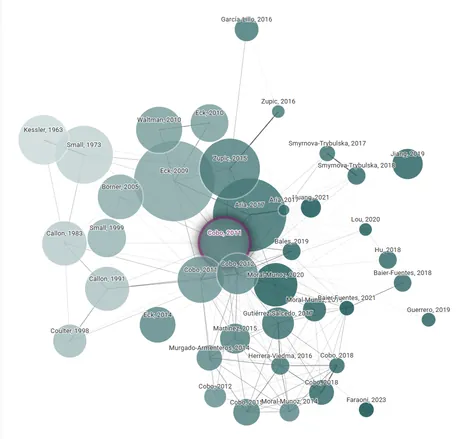
A science mapping software tool excellent for literature review and identifying gaps
Features of a Connected Papers graph:
- Node Size - Proportional to the number of citations. Large nodes indicate cited, influential papers.
- Node Darkness - The darker the node is, the most recently it was published.
- Distance - Distance between nodes indicates how similar the papers are.
- Line Darkness - Strength of their connection is indicated by the thickness of the line connecting them.
By scanning the map for nodes that are disconnected or isolated from the main clusters, you can spot underexplored niches.
ResearchRabbit
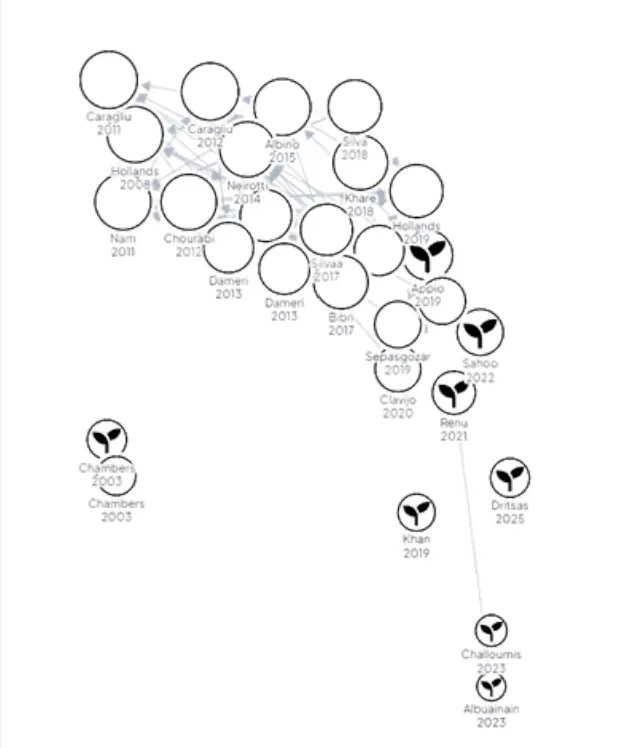
Visual literature mapping tool for academic research. It helps you discover, explore, and organize scholarly studies by mapping the connections between articles, authors, and citations instead of relying on standard keyword searches.
Features of a ResearchRabbit graph:
- Interactive Nodes: Each paper appears as a node. Bigger nodes mean a paper has more citations.
- Color-Coded Timelines: Dots are colored by their publication year. This shows you the age of a study at a glance.
- Citation Webs: Lines connect the dots to show "cited by" and "cites" relationships.
- Graph Layouts: A timeline view organizes papers chronologically, while a network view groups them by similarity.
- Author Networks: The graphs can map out co-authorship. This helps you see how researchers and institutions collaborate.
- Deep Dives: You can click on any node to read its abstract, view its specific references, and spawn brand new graphs based on that specific paper.